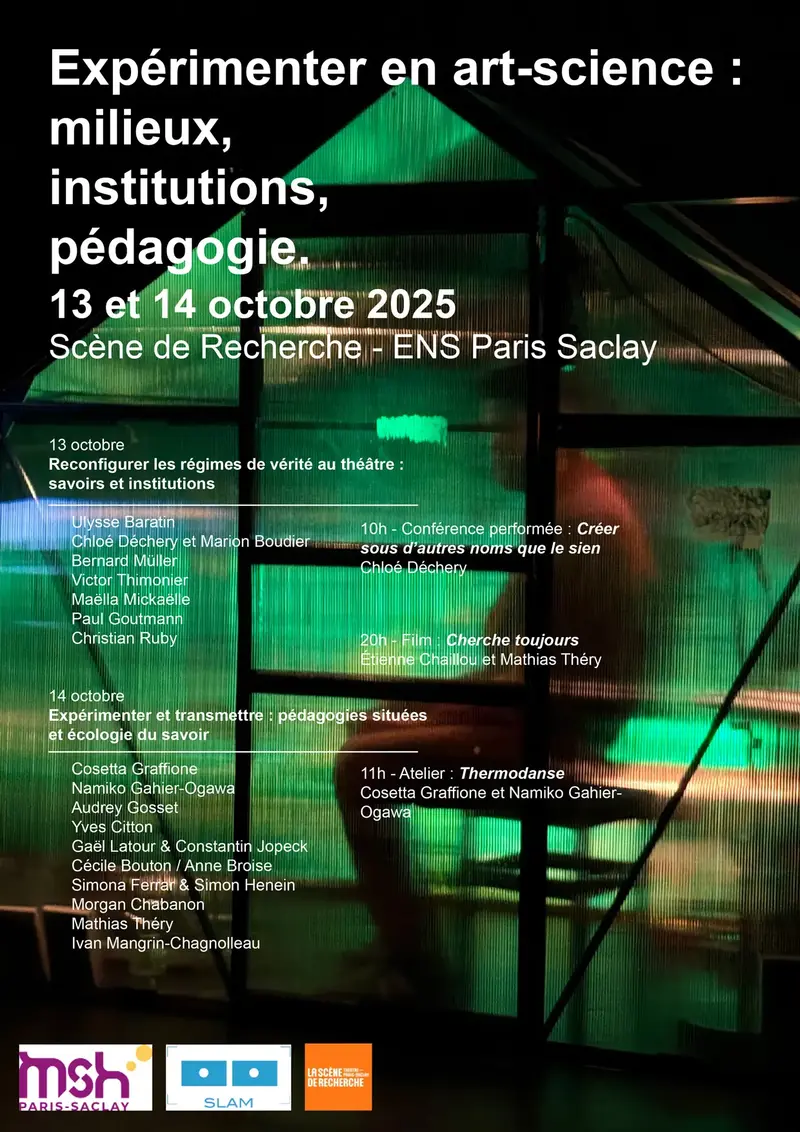
Conference: Experimenting in the Arts and Sciences
environments, institutions, pedagogy
La Scène de recherche is pleased to host a symposium organized by Audrey Gosset, a graduate of the École Normale Supérieure (ENS) with an agrégation certification and a temporary teaching and research associate at ENS Paris-Saclay. In organizing this event, she is joined by Victor Thimonier (associate professor of theater studies at the University of Évry–Paris-Saclay and an associate artist with La Scène de recherche) and Morgan Chabanon (associate professor at CentraleSupélec).
This highlight event brings together researchers, artists, and scientists to rethink the relationship between the arts and sciences. Too often confined to rigid dichotomies, these fields are here explored not only in terms of their fruitful collaborations but also in terms of their areas of uncertainty, tension, and doubt. Together, they share stories, tools, and practices to better understand how these two worlds enrich one another.
Monday, October 13 – Reconfiguring Regimes of Truth in Theater: Knowledge and Institutions (9:30 a.m.–9:00 p.m.)
- 9:30 a.m. Welcome coffee – Espace Simondon
- 10:00 a.m. Opening Remarks — Ulysse Baratin – Scène de Recherche
- 10:15 a.m. – 12:30 PM Performed Lecture — Chloé Déchery & Marion Boudier – Scène de Recherche
Maps of Return — Chloé Déchery & Marion Boudier - 12:30 PM – 1:00 PM Describing Through Play: Praxeography, Ethnodramaturgy, and Situational Theater — Bernard Müller
- 12:30 p.m. Lunch
- 2:00 p.m. – 2:30 p.m. “The People Are Not Asking You to Work with the Collège de France” – Victor Thimonier
- 2:30 PM – 4:00 PM Discussion on *The Little Tragic Breviary for 21st-Century Human Animals*, a production by the Tf2 theater company directed by Jean-François Peyret — Maëlla Mickaëlle
- 4:00 PM – 4:15 PM Break
- 4:15 PM – 4:45 PM Sound experiments for the theater – Paul Goutmann
- 5:30 PM – 6:15 PM Arts and Sciences - Figures of a Relationship — Christian Ruby
- 6:15 PM Buffet
- 7:45 PM–9:00 PM Screening Always Searching (film by Étienne Chaillou and Mathias Théry)
Tuesday, October 14 - Experimenting and Sharing: Situated Pedagogies and the Ecology of Knowledge (9:30 a.m.–7:30 p.m.)
- 9:30 a.m.–10:00 a.m. Welcome coffee – Espace Simondon
- 10:00 a.m. – 11:00 a.m. Sound installation : Paroles Ecotones – Research Stage
- 11:00 a.m. – 1:00 p.m. Participatory workshop: Thermodance
- 1:00 PM – 2:30 PM Lunch
- 2:30 PM – 3:00 PM Investigation-Publication: The Challenges of Research-Creation According to Vilém Flusser — Yves Citton
- 3:00 PM – 4:00 PM Filming in the Lab — Mathias Théry
- 4:00 PM – 4:15 p.m. Break
- 4:30 p.m. – 6:30 p.m. Roundtable: Rethinking Transmission
Gaël Latour & Constantin Jopeck
Cécile Bouton / Anne Broise
Morgan Chabanon
Simona Ferrar & Simon Henein - 6:30 PM – 7:00 PM Pedagogical and Epistemological Challenges in Art-Science Practices - Ivan Magrin-Chagnolleau
- 7:00 p.m. Closing Lecture
- Starting at 7:30 p.m. Buffet
This conference is funded by the Maison des Sciences sociales et des Humanités Paris-Saclay.
This conference is funded by the Maison des Sciences sociales et des Humanités Paris-Saclay.
Detailed Program
Chloé Déchery & Marion Boudier
Title: Performed Lecture: Creating Under Names Other Than One’s Own followed by The Game of Return Cards
Biographies: Born in 1980, Marion Boudier is a playwright and lecturer-researcher in the performing arts. Passionate about creative processes and teamwork, she has built her career by ensuring that her three roles—playwright, researcher, and teacher—nourish one another and work in synergy to benefit a wider audience. For over 20 years, she has engaged with diverse audiences and in a variety of contexts—in creative spaces, at art schools, and through workshops, meetings, and conferences.
After studying modern literature and completing a dissertation on the representation of reality in contemporary dramaturgy, Marion Boudier developed a practice in prospective and documentary dramaturgy within the Compagnie Louis Brouillard to support the writing of stage plays. As dramaturg for Joël Pommerat’s productions since 2013, she is also responsible for compiling texts and overseeing their editorial process for Actes Sud, creating educational resources, organizing audience engagement events, and writing production and communication materials.
She also collaborates with actress and director Eve-Chems de Brouwer, storyteller Gérard Potier, and writer-director Guillermo Pisani. Depending on the project, she collaborates with researchers from other disciplines, particularly in the social sciences, but also in geophysics and robotics. Since 2022, she has been an associate researcher at the Laboratoire d’Histoire Permanente at the Centre Pompidou and has collaborated with choreographers on the topic of archives (Carolyn Carlson, Bintou Dembélé). In 2023–24, she is a research artist-in-residence at the Studio Théâtre de Vitry to establish creative workshops exploring performers’ uses of documentation (the ADOC project).
She is also an associate professor at the Université Picardie Jules Verne (Amiens) and a member of the Institut Universitaire de France, she served as director of the Department of Performing Arts (2019–21), overseeing the recruitment of guest artists and the establishment of agreements with local partners. In addition to these experiences in co-creation, institutional collaboration, and team management, she has been co-leading the Performer Les Savoirs research and creation program with Chloé Déchery since 2018. With the support of numerous academic and cultural partners, they organize one-day labs, seminars, and workshops by inviting artists and artist-researchers and commissioning new works. Their work contributes to the dissemination of performance studies and new artistic research practices in France.
Chloé Déchery is a performance artist and researcher in performance studies. Her creative work emphasizes experimentation, process-oriented approaches, and collaborative dynamics. Depending on the project and its specific requirements, she draws on performative or choreographic forms to position her work at the intersection of autobiographical research, documentary inquiry, and fictional elaboration. Her work focuses in particular on questions of language and communicability, memory and identity construction, and diplomatic relations among the living.
A trained performer, Chloé Déchery has worked in France, Australia, and Great Britain—where she lived for 10 years—with choreographers and directors such as Ivana Müller, Olivier Normand, Cristèle Alves Meira, Anne Bean, Sheila Ghelani, Rajni Shah, Improbable, Luke Dixon, The Fondue Set, Jane McKernan, and Emma Saunders. Since 2009, she has been creating performative works that explore the intersection of Live Art, choreography, and autobiographical performance. Among her most recent pieces are *Bardane and Me*, a score for a 40-year-old woman and a wild plant, created in 2022, and *On The Horizon*, a choreographed piece created in 2017, designed for public spaces and intended to be listened to through headphones. Her work, carried out through the association “moustache,” founded in 2009, is supported by Arts Council England, the British Arts Council, Eur ArTeC, and the Institut français.
A graduate of the École Normale Supérieure—Lettres et Sciences Humaines in Lyon and a certified teacher of modern literature, Chloé Déchery is also a theorist and lecturer in theater and performance studies at thethe University of Paris 8. With a Ph.D. in aesthetics and the performing arts focused on bodily practices in contemporary performance, Chloé Déchery has taught the theory and practice of performance in France (École Normale Supérieure-Ulm, University of Paris Nanterre, Lille Institute of Political Science), in the United Kingdom (University of Surrey, Queen Mary University, Goldsmiths University, Royal Central School of Speech and Drama), and in Australia (University of Wollongong).
Drawing on this threefold perspective—as an artist, theorist, and educator— Chloé Déchery takes a close interest in the dynamics of hybridization between practical experimentation, artistic innovation, and theoretical development. In doing so, she regularly proposes and facilitates opportunities for research and artistic experimentation that take various forms: performance, workshop, public reading, laboratory, performed lectures, and theoretical or performed writing.
Chloé Déchery is artistic co-director, alongside Marion Boudier, of Performer Les Savoirs, a curatorial platform and artistic research program created in 2018.
Abstract:
I. “Creating Under Names Other Than One’s Own” is a performance-lecture that explores invisibilized or hidden practices of women’s writing, including heteronymy—the act of writing “under a name other than one’s own.”
Armed with a collection of letters from her grandmother’s correspondence—which she discovered in the closets of a pink bathroom— Chloé shares the findings of an investigation that takes her from a family home in Picardy to Douala, Cameroon, via an archive in Vanves.
We attempt to strike a balance between the more or less consensual appropriation of manuscripts and a repressed desire to write. Halfway between a lecture, investigation, and portraiture, the performance explores what heteronymy—when practiced by female authors—reveals about the desire to speak out, whether as a mother in 1951 or a researcher in the 2020s.
Performer and researcher Chloé Déchery adopts an investigative approach on stage that includes an overhead camera, objects displayed on the table (letters, books, photo albums, scarves, and tablecloths), and archival films. In doing so, she opens the box of family intimacy as one might open Pandora’s box to reveal the complex dynamics that unfold between what is hidden and what is revealed, between the desire to write and the desire to say “I” in the patriarchal and colonial society of 1950s France.
II. As a post-performance discussion, Marion Boudier and Chloé Déchery invite the audience to engage in a conversation about the themes of the performance-lecture Creating Under Names Other Than One’s Own, based on the Game of Return Cards, a playful tool they designed and created to facilitate speaking up and providing feedback on a performance—whether in progress or completed.
The card game, designed in collaboration with illustrator Éric Valette, aims to contribute to the development of a “culture of feedback” in the fields of artistic creation, presentation, and education. How can we talk about what we’ve seen—whether we liked it or didn’t understand it—after a performance or a prototype presentation? What methodologies can we develop so that the dialogue around feedback among artists, companies, venue managers, programmers, and audience members is not a constraint but a resource for the work and working conditions?
Le Jeu des Cartes du Retour builds upon the work of the two researchers Chloé Déchery and Marion Boudier, whose book Artist-Researchers, Researcher-Artists – Performing Knowledge, published in September 2022 in the ArTeC collection, is part of this work.
“A unique editorial project that cleverly uses gamification to serve an artistic purpose. ” Mathias Daval, IO Gazette
Bernard Müller
Title: Describing Through Play: Praxeography, Ethnodramaturgy, and Situational Theater
Biography: Bernard Müller is an anthropologist. He explores contemporary popular narrative constructions—historical discourses, myths, rumors, fictions, or utopias—through an approach that combines ethnography, theater studies, ethnoscenology, and performance studies. His research, which began in 1995 with a Yoruba theater troupe in Nigeria, led him to develop a method of ethnodramaturgy in which the stage becomes a tool for inquiry. He has since worked in Nigeria, Togo, Brazil, Germany, and France, also conducting provenance research and a study of memory regarding the colonial history of museum collections. A member of the LAP (EHESS), he co-leads the seminar “Objects and Things in the Social Sciences” and, in 2025–2026, the workshop “Anthropology Put to the Test of Plural Forms of Writing ” (with C. Pasqualino, A. Fiorentini, M. Lamotte, and A. Bertina). He serves on several editorial boards, including COMMUNICATIONS (No. 116, Dramaturgies of Reality, 2025), and coordinates the association CURIO – Workshop on Potential Anthropology.
Abstract: This paper explores the convergences between dramaturgy and praxeographic anthropology. Describing or reenacting an action amounts to grasping its implicit rules and situational logic. Drawing on Bazin, Wittgenstein, Schechner, and Goffman, he proposes the concept of “dramaturgy of the real,” in which every social interaction is reenactable yet always unique. Ethnodramaturgy refers to this method, which transposes social stage directions onto the stage to test their effects. The stage thus appears as a veritable laboratory for inquiry.
Victor Thimonier
Title: “The People Are Not Asking You to Work with the Collège de France”
Biography: Victor Thimonier is an associate professor of theater studies at the University of’Evry Paris Saclay and a member of the SLAM laboratory, specializing in research-creation in theater. He is also a director and artistic director of the Les Temps Blancs theater company (www.lestempsblancs.fr).
Abstract: Would it be reasonable to expect the public to ask government authorities to produce performances stemming from a conversation between a demanding artist and a professor at the Collège de France? Through an exploration of the works of Jean-François Peyret and Alain Prochiantz, we will examine how the interstices of institutions can give rise to unique theatrical forms that demand different attitudes from the audience.
Maëlla Mickaëlle
Title: Discussion on *Le Petit bréviaire tragique à l'usage des nimaux humains du XXIème siècle*, a production by the Tf2 Jean-François Peyret company
Biography: Maëlla Mickaëlle is a multidisciplinary artist who works at the intersection of dance and visual media. A filmmaker, multimedia artist, and performing arts videographer, dancer, and musician, she is also the co-founder of Milla Studio. She has collaborated for many years with director Jean-François Peyret, for whom she creates videos, and with visual artist Agnès de Cayeux as a dancer. Maëlla Mickaëlle has directed several short films, including “Triple boucle” in 2020, which addresses the issue of abuse in sports.
Abstract: Maëlla Mickaëlle will present images from her creative process in the studio and on the theater stage as part of Jean-François Peyret’s Tf2 company. This material will provide an opportunity to reflect on the art-science composition process and the institutional challenges encountered in the production of the company’s latest show. She will also discuss with Victor Thimonier the role of female technicians and creators within a theater company or in a laboratory.
Paul Goutmann
Title: Sound Experiments for the Theater
Biography: Paul Goutmann is a French musician, composer, and researcher. He defended his dissertation in 2023: “Operational Representation for the Spatial Processing of Sound: An Approach to Music and Software Creation” under the co-supervision of A. Bonardi and A. Sèdes as part of ArTEC. His research was conducted at the Center for Research in Computer Science and Musical Creation (CICM, Musidanse) and focuses on the spatial processing of sound and the interactions between computer science and musical composition. His reflections on the spatialization of sound extend into his practice in computer music production, sound recording, and creation for the theater. He has collaborated with several theater directors (L. Favret, S. Mirzai, A. Acerbis, V. Thimonier) and was a recipient of the Création en Cours grant from the Ateliers Médicis. As part of the “Habiter (avec) Xenakis” project, in 2022 he presented a spatial arrangement of I. Xenakis’s piece *Voyage Absolu des Unari vers Andromède* for the planetarium at the Cité des Sciences (a Philharmonie de Paris event) and for the *Xenakis Alive* concert (Onassis Stegi, National Conservatory of Athens). Since 2023, he has been collaborating as an artist-researcher and electronic musician with the duo QUID.
Christian Ruby
Title: Arts and Sciences (A&S) Figures of a Relationship
Biography: Christian Ruby, philosopher, member of the editorial board of *Raison présente*, of the ADHC (Association for the Development of Cultural History), of the ATEP (Tunisian Association for Aesthetics and Poetics), as well as of the Observatory for Creative Freedom. He has just published: *La fécondité du vide*, Paris, MkF Éditions, 2024. Reference website: www.christianruby.net
Abstract: Focusing on the potential and actual relationships between Arts and Sciences (A&S), this discussion is grounded in two necessary distinctions: avoiding subjecting this relationship to an abstract universalism according to which everything would be indiscriminately identical, especially when viewed through the lens of an absolute; and rejecting the “exoticism”¹ of one over the other (in both directions). The logic of this framework (A&S) is the positive tension inherent in mutual engagement, which is already at work in certain practices, but which is not yet fully intelligible from an epistemological standpoint, given the number of contradictory notions that claim to account for the need to practice thinking about a new dynamic between the sciences through the arts and the arts through the sciences.
Mathias Théry
Title: Discussion on the documentary *Cherche toujours*
Biography: Mathias Théry is a French filmmaker, born on March 9, 1980. Trained at the École des Arts Décoratifs in Paris, he has been making films for some twenty years that explore reality through various narrative forms. He is best known for co-directing, with Étienne Chaillou, the documentaries *La Sociologue et l’Ourson* (2016) and *La Cravate* (2020).
Yves Citton
Title: Investigation-Publication: The Challenges of Research-Creation According to Vilém Flusser
Biography: Yves Citton is a professor of literature and media at Paris 8 University and a member of the Institut Universitaire de France. Until 2021, he served as executive director of EUR ArTeC (Arts, Technologies, Digital Media, Human Mediation, and Creation). He co-edits the journal Multitudes and has published, among other works, La Machine à Faire Gagner les Droites (2025), Politics of Curiosity (with Enrico Campo, 2024), Generations of Collapsonauts (with Jacopo Rasmi, 2020), Mediarchy (2017), Toward an Ecology of Attention (2014). His articles are available for free at www.yvescitton.net.
Abstract: This presentation will explore some of the insights that can be gained by reinterpreting—as challenges to our conceptions and practices of research-creation—the proposals made by the philosopher and media theorist Vilém Flusser (1920–1991) in several texts recently republished under the title Arts, Sciences, Technologies (Presses du réel, 2025).
Gaël Latour & Constantin Jopeck
Title: Roundtable: Rethinking Transmission - Inspirations in Optics and Art: Practice and Interpretation
Biographies: Gaël LATOUR is a faculty member and researcher at Paris-Saclay University and conducts his research at the Laboratory of Optics and Biosciences (École Polytechnique, Palaiseau). He works on the development and application of optical microscopy techniques in the biomedical field, as well as in the field of heritage sciences to support the conservation and restoration of cultural heritage objects. As a professor, he strives to bridge the gap between his research and his teaching. He therefore offers courses in optics to demonstrate the application of optics in relation to works of art, whether in terms of their visual appearance or through the use of analytical tools to assess the condition of the works.
Constantin Jopeck is an artist at Le Fresnoy—National Studio for Contemporary Arts.
Abstract: This course, titled “Optics and Art,” provides an opportunity for dialogue and exchange between a physicist specializing in optics and an artist. For students, the objectives are to engage in weekly artistic practice with no prerequisites, to deepen their understanding of physics concepts, and to become aware of an art-and-science approach. By combining artistic and scientific experiences, this course is led by a physicist-artist duo who design the curriculum from start to finish to ensure its relevance and quality across both disciplines.
Cécile Bouton
Title: Panel Discussion: Rethinking Knowledge Transmission - What if theater or origami changed the way we learn at the university!
Biography: As a biologist and researcher at the CNRS transitioning into the field of educational sciences, I design educational approaches based on collective intelligence and examine them with a view to developing the psychosocial skills of teachers and students.
Abstract: I would like to present two pedagogical approaches based on forum theater, which allow students and teachers to practice active listening and openness to others’ perspectives. These qualities are essential for collaboration and foster a positive teacher-student relationship. The continuing education program aimed to improve this relationship, while the initial training program offered students the role of co-creators of spaces for collective reflection on science-society issues.
Anne Broise
Title: Roundtable: Rethinking Knowledge Transmission - What if theater or origami changed the way we learn at the university!
Biography: Anne Broise is a lecturer in mathematics at Paris Saclay University and director of the MEEF master’s program for training middle and high school mathematics teachers.
Abstract: For the past three years, an artistic practice workshop has been integrated into the initial training of mathematics teachers: origami or mathematical theater as part of the course units “Maths, Art and Culture” and “Enriching Your Teaching.” These workshops aim to improve participants’ ability to listen to others and take their needs into account. They also aim to encourage reflection on the implicit assumptions in instructions, whether material or conceptual. Finally, these workshops require trainees to reflect on their teaching and find alternative ways to discuss certain mathematical concepts with their students. The professional skill these workshops seek to enhance is the teacher’s reflective practice.
Morgan Chabanon
Title: Roundtable: Rethinking Knowledge Transmission
Biography: Morgan Chabanon is an associate professor at CentraleSupélec, Université Paris-Saclay. His research focuses on the physics of mass and heat transfer in porous and biological media. Since 2022, he has created and led the Thermodanse project, which aims to develop participatory choreographies that engage participants in live models of advanced scientific concepts. He also serves as the science and society at CentraleSupélec.
Abstract: We will discuss the emergence of educational innovations in the spaces opened up byart within scientific institutions. We will discuss the value of integrating artistic practice into science education, the role of these initiatives for the community, and the stance of scientific institutions toward these art-science-education projects.
Simona Ferrar & Simon Henein
Title: Roundtable: Rethinking Knowledge Transfer - Collective Creation, Improvised Arts, and Engineering: EPFL Initiatives
Biographies: Simon Henein is a professor of Microtechnology at EPFL and has been director of the Laboratory for Micromechanical and Watch Design (INSTANT-LAB) since 2012. Since 2017, he has also been teaching a master’s-level seminar titled “IMPROGINEERING – Collective Creation: Improvised Arts and Engineering,” which introduces students to improvisational practices in dance, theater, and music and encourages them to explore processes of collective creation in the fields of science and technology. He led a research project titled “The Performing Arts as a Pedagogical Tool in Higher Education” (ASCOPET) in collaboration with the Institute of Psychology and Education at the University of Neuchâtel. Affiliated with the EPFL College of Humanities, he has directed the Performance Lighthouse since 2024, a platform for promoting performing arts projects led by EPFL students. He currently directs the dance company L’Âme-de-Fonds, which he founded in Neuchâtel in 2013.
With a degree in Literature from the University of Geneva, Simona Ferrar is a performance artist, dancer, and playwright. She founded the company The Fig Tree & The River in 2021 and regularly joins other artistic teams as a performer and dramaturg. Since June 2024, she has been collaborating with Prof. Simon Henein to coordinate the Performance Lighthouse and develop the platform’s artistic projects.
Abstract: We will present the IMPROGINEERING and DÆNCITY projects, both designed to introduce EPFL students to practices derived from improvisation, as practiced in the performing arts. Through workshops, artist residencies, reflection processes, academic research, and public performances, these experiences increasingly demonstrate the value of facilitating access to artistic practices within the curriculum of a polytechnic school, while building bridges between the campus and the city’s cultural venues.
Ivan Magrin-Chagnolleau
Title: Pedagogical and Epistemological Challenges in Art-Science Practices
Biography: Ivan MAGRIN-CHAGNOLLEAU is an artist-philosopher who devotes himself primarily to academic research and teaching, as well as to artistic creation. He is affiliated with Chapman University in California. His areas of interest include: the creative process and its phenomenological dimension, art and philosophy, artificial intelligence and creativity, art and spirituality, art and the environment, and art and ethics.
ivanhereandnow.com | @ivanhereandnow
Abstract: What is an art-science practice? What does creative research entail? How do art and science interrelate in an art-science practice? How can such practices be applied to climate and environmental issues? An example: the Arts&Sciences team at Labos1point5 and its projects. How can these approaches be adapted for educational settings? An example: an educational experiment at Chapman University, “How Art Can Help Us Save The Planet.”
Workshop participants Sciences/Arts
Title: Ecotones Words
Workshop participants and co-creators: Raphaël Honigsberg (ENS Paris-Saclay), Mattheus Burkhard (Université Paris-Cité), Antoine Covolo (ENS-PSL), Tristan Gamot (Institut Polytechnique de Paris, Sorbonne University), Audrey Gosset (ENS PS), Pauline Gosset (University of Tours), Emile Le Lièvre (ENS PS), Clément Morhain (CentraleSupélec).
Abstract: This presentation invites the audience to listen to an audio documentary composed of interviews conducted with doctoral students in theoretical and experimental sciences following a workshop organized by Arts/Sciences workshop at the Scène de Recherche at ENS Paris-Saclay. Their words reveal doubts, tensions, and questions about their research practices. More than just a recap of the workshop, the aim is to open a space for reflection on the production of knowledge, by intersecting the issues of gender, ecology, and institutional conditions. This polyphony thus becomes a living environment where a more situated, relational, and sensitive scientific practice is experimented with—a space for caring for research.